Models
The Models tab downloads a working set for each family in one click — the model and the parts it needs, to the right place. The ones marked Recommended fit your GPU.
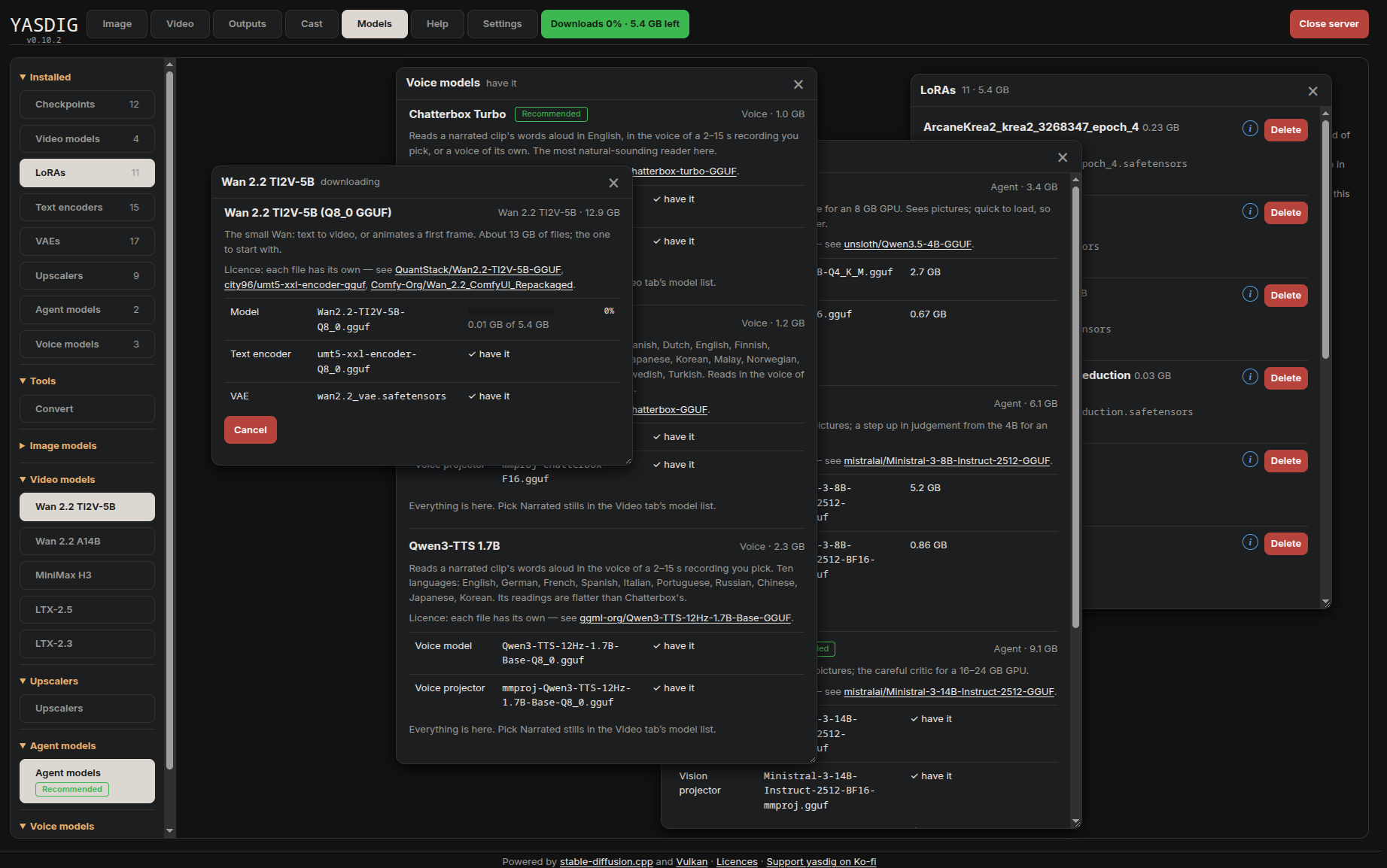
Families
| Family | Good for | On the card |
|---|---|---|
| SD 1.x, SD 2.x, SDXL | The huge library of community checkpoints and LoRAs | SDXL: a 6.9 GB file |
| Z-Image Turbo | Fast: 8 steps | About 11 GB |
| Flux.2 Klein 4B / 9B | Fast (4 steps); takes reference images and can Edit | About 9 / 19 GB |
| FLUX.3 Klein / Klein Base | 16 steps / 20-step base; reference images and Edit | About 11 GB |
| Flux.1 schnell / dev | 4-step drafts / detailed 20-step renders | About 18.5 GB |
| Krea 2 Turbo | 8 steps | About 15 GB |
| Qwen-Image | The largest here (20B); strong at text in pictures | About 17 GB |
| Qwen-Image 2.1 | 7B, strong lettering, trained at 2048²; 8 steps with Turbo | About 18 GB |
| Iris-3B Turbo / Iris-3B | Small: draws in pixels with no VAE; Turbo in 4 steps | About 8 GB |
| MOSS-Image | Layout and lettering; 50 steps at real CFG, so not fast | About 16 GB (INT8) / 21 GB (BF16) |
| MiniMax H3 Image | Distilled, 6 steps; takes reference images and can Edit; shares H3 video’s encoder, streamed from the SSD | About 21 GB (INT8) / 13 GB (W4A8) |
| FLUX.1 Fill | Powers Extend; not used for generating | About 18.5 GB |
Video: Wan 2.2, Wan 2.1 VACE, MiniMax H3 and LTX-2.3/2.5 — see Video.
Less memory than that?
The Memory setting keeps the model in system RAM or streams it from the SSD, and when a render runs out of memory anyway, the error offers the ways out. The Memory guide →
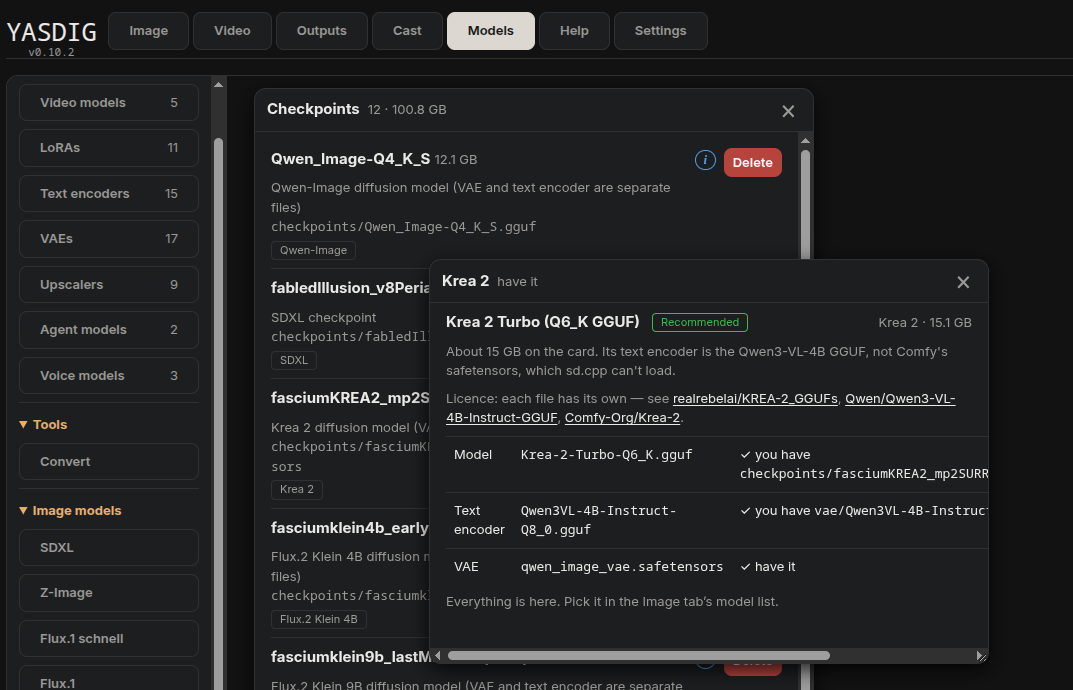
Any file, recognised by what's inside
.safetensors, .gguf or .ckpt: YASDIG reads
every file to find out what it is, so names and folders don't matter. Model files
are read, never run — there is no Python inside. Installed lists every file
you have with the families it serves, and a note on any of them behind its blue
i.
Convert
Shrink a model to GGUF — q8, q4 and others — so it fits your card. fp8 files run at twice their size on AMD cards; Convert turns one into a GGUF that runs at its real size.
Read more: Intro to models →